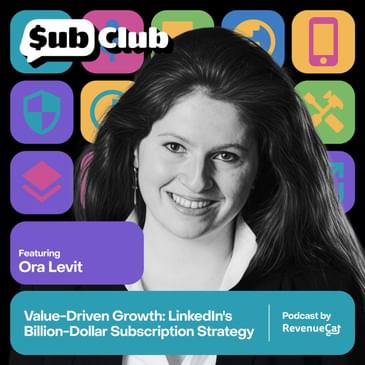
On the podcast: LinkedIn’s value-driven growth philosophy, how they personalize experiences and plan offerings based on user intent, and the complexity of running over a thousand experiments a year.
Top Takeaways:
🌱 Growth follows value – Users pay and stay only if you keep delivering real, evolving benefits.
🎯 Personalize by intent – Tailor plans, features, and messaging to what users are actually trying to achieve.
📊 Test like a scientist – A thousand+ experiments a year show that data beats debate when finding what works.
🔄 Retention isn’t linear – Boomerang users prove that churn isn’t final if you re-engage with fresh value.
🤖 AI is a tool, not the story – Use it to remove friction and add relevance, but don’t sell the magic—sell the outcome.
About Ora Levit:
👨💻 Vice President of Product Management at LinkedIn.
📈 Ora manages LinkedIn’s billion-dollar online subscription businesses, growing both the free weekly active user base and adding value for LinkedIn Premium subscribers.
💡 “Our offering changes over time, and as I mentioned, we believe in value-driven growth. We add a lot of value. And so the Premium that you've seen if you subscribed two years ago is not the Premium of today. It's a very different product, and I want you to try it out.”
Follow us on X:
David Barnard - @drbarnard
Jacob Eiting - @jeiting
RevenueCat - @RevenueCat
SubClub - @SubClubHQ
Episode Highlights:
[0:51] Value add: How LinkedIn centers value-driven growth in their product development.
[8:40] The long game: The importance of optimizing for and measuring long-term revenue.
[9:57] Pay to play: Where to draw the line between free and paid features.
[17:59] Put it to the test: Ora and her team prioritize A/B testing and user feedback over internal debates about feature ideas.
[23:32] Take it personally: The role of AI and LLMs in personalizing in-app experiences.
[27:47] Here today (and tomorrow): Strategies for retaining users in the long term and winning back churned users.
[34:52] The AI touch: LinkedIn’s philosophy on incorporating AI features to add value to their product.
[39:44] Two (or three) for one: Leveraging strategic partnerships to add bundled perks to a premium subscription offering.
[41:43] Pulse check: Monitoring earnings calls, reports, books, and podcasts to stay in step with the current state of the subscription app industry.
David Barnard:
Welcome to the Sub Club Podcast, a show dedicated to the best practices for building and growing app businesses. We sit down with the entrepreneurs, investors, and builders behind the most successful apps in the world to learn from their successes and failures. Sub Club is brought to you by RevenueCat. Thousands of the world's best apps trust RevenueCat to power in-app purchases, manage customers and grow revenue across iOS, Android and the web. You can learn more at revenuecat.com. Let's get into the show.
Hello, I'm your host, David Barnard, and with me today RevenueCat, CEO, Jacob Eiting. Our guest today is Ora Levit, VP of Product Management at LinkedIn, where she leads revenue and product teams focused on LinkedIn Premium subscriptions. On the podcast, we talk with Ora about LinkedIn's value-driven growth philosophy, how they personalize experiences and plan offerings based on user intent and the complexity of running over a thousand experiments a year. Hey, Ora, thanks so much for joining us on the podcast today.
Ora Levit:
Thank you for having me. It's a pleasure to be here.
David Barnard:
And, Jacob, nice to have you back on after our bit of a hiatus with your busy summer schedule and my busy schedule.
Jacob Eiting:
I just get owls in the window that tell me I have to come to a Sub Club Podcast and it's been a while since we had one, so I'm excited to be here today.
David Barnard:
So, Ora, when you and I were talking ahead of the podcast about potential topics, one of the things you mentioned to me is your approach to value-driven growth and the whole team thinking about it in that way. And so I think that's really the best place to start this podcast is, what did you mean by value-driven growth? How do you think about it? How do you talk about it inside LinkedIn? And then I think that's just a great framework for the rest of the podcast talking about all the different tactics and other topics.
Ora Levit:
For sure. So within LinkedIn, Premium offers solutions for consumers and small businesses to help individuals accelerate in their career, get promoted, find a new job, build a business, scale their business, find leads, build their brand and hire people. And essentially, what is key for us is that we provide benefits and value that helps members achieve those tasks. There's many ways to drive growth. For us, what was critical is to make sure that we drive that growth by helping our members achieve their jobs to be done.
And so within the last two years I want to say, we added over 20 different benefits across everything between helping you get specific insights on how to get hired and improve models that help you understand on which jobs you're more likely to hear back and how you match and rank for that job, to help with making your profile stand out, from adding a cover photo that rotates, to highlighting your achievements and awards and recommendations from friends, to helping you fill your profile details, to dedicated events and learning courses and a variety of other features that ultimately help members get the job that they're coming to us to get and pay for, get then.
And our belief is that the more value we provide and we explain to members how they can use it and how it helps them in their tasks they're trying to achieve, the more likely they are to come for that value and stay for that value. And so we're growing both acquisition and retention. And so a lot of our growth was around that.
David Barnard:
Does that play out in any kind of specific processes inside LinkedIn? Do you have a default product spec where there's a whole section on where the product manager has to specifically say, "This is this specific value and how valuable we think it is," or how does that play out in the day-to-day product decisions and experimentation and that sort of thing?
Ora Levit:
For sure. All our specs specify who the member is that we're trying to target with an offering and what's the job to be done that we're trying to solve for that member. There's specific use cases and specific member scenarios. We would outline them and the specs would include that, but ultimately, it's heavy focused on making sure that you're growing value. And so we have a full team that's dedicated to the value that our subscriptions are providing and they're building new features and enhancing adoption of features and reaching the functionality of existing features to ensure we continue growing the value of those features. And that team size is similar to the team that drives growth from better pricing, discovery, packaging, promotions, et cetera because it's really the core of what we do and how we operate.
Jacob Eiting:
People are pretty good. If there's no value, they'll stop paying, or if they've reached their limit of derived value, they'll just churn out.
Ora Levit:
Yeah, I think for a lot of companies who build value and they're like, "Okay, it's great. Now let's go home for growth," and then they forget that the value is what brought them and they go home and grow for many years, but value is something that we believe needs to continue to be delivered ongoingly. The traditional product lifecycle, at some point, you grow and then you mature and you have to launch new value to continue that growth trend and disrupt it. And so what we're trying to do is continuously launch more and more value so that our users and members always have an opportunity to find what to come to LinkedIn for and how to accomplish their jobs to be done better through that value.
Jacob Eiting:
I think also people just get really used to, consumers get really used to whatever they're doing, right? And so if there's not continuous novelty, they're going to look at the value ... Even if something they valued at the current price a year ago, if nothing has changed, I always think about this, it's how you beat inflation, right? You just keep adding stuff to the product and then you can hold your pricing or maybe even increase it, but if you don't, yeah, it's purely extractive as you were saying. You're eventually going to extract all the value and then your growth team ... And also just conjecture, if that's when growth teams get a bad rap for ruining products, trying to extract all the growth, if that's all you focus on, they will. You know what I mean? They will drive features that actually aren't good for the users. All they're doing is maximizing value extraction.
From my perception as a LinkedIn user for as long as I can remember, I don't know how it's possible, but you're all still adding stuff in 2025. And the numbers, I don't quote them here so I don't drive your PR team mad, but your growth has been better than Facebook in some axis and stuff like this, which is surprising for a social network ostensibly in the year 2025. It must be because of this, I would assume.
David Barnard:
Are there numbers that you all share publicly?
Ora Levit:
LinkedIn has over a billion members. We have a healthy subscriber base. Our subscription businesses are several billion dollars of annual run rate.
David Barnard:
Wow. That's incredible. And how does that value-driven growth approach play into the metrics you track and north star metrics and how you think about what you look at day in, day out as you judge how the business is moving?
Ora Levit:
Yeah. So we have a series of different metrics. We look at how many members we acquire, how well they retain with the subscription between trial and paid, but also throughout the duration of their paid subscription. We look at what we call a Premium session, which is a session in which a Premium member interacts with a Premium feature and we want more essentially Premium members to come more frequently, interact more, and for us, it's a sign of value that they're arriving for the product, which is a sign that they'll continue staying us for the long term.
But overall, we optimize as a true north of the business for long-term revenue and I say long-term revenue, not short-term revenue because there's a lot of revenue we forego and don't want to take because we believe it'll squeeze the funnel in the way that we are not interested in. And so we always optimize for long-term longevity and I would believe that members [inaudible 00:08:10]. If we would deliver value, they would buy the product, and if we continue delivering on it, they will stay with it.
David Barnard:
It's so refreshing to hear this and you would just I guess assume such a mature company would operate this way, but so many folks in this industry and the consumer subscription industry don't and they are more extractive and willing to make sacrifices.
Jacob Eiting:
They just obsess about tactics without thinking about the underlying physics of the system, which is what this is describing. And the tactics are important, right? I'm sure everything you all do on a micro basis needs to be measured and done, but if you forget about the big picture, eventually it will lead you to ruin.
Ora Levit:
Yeah, subscription business are very complex, A lot of things that you do move metrics in different direction, so you have to remember what's the true north. And we made it easy for ourselves to make the right decision by having a location for our revenue. We want take revenue that essentially is downside because it's better for members and it's better as a result for us as a business. And so we always emphasize that we optimize for long-term revenue.
David Barnard:
Are there specific ways you measure that long-term revenue? Do you have a predictive LTV model or how do you actually measure that?
Ora Levit:
Yeah, we do. We measure all ramps that we do, all initiatives by analyze bookings, which is one year booking and then we model our one-year revenue and then we model revenue for experiments that we believe would change over time such as pricing experiments and others on a five-year horizon. And so we plot how that would look over time because those outcomes might change and make decision based on the five-year view and not the one-year view.
Jacob Eiting:
That makes sense. I was thinking just, I guess from a premium perspective on LinkedIn, your retention may be varying, but the underlying user retention of LinkedIn I imagine extremely high that I can't think of why somebody would stop being a user completely. They might go dormant for a while if they're not thinking about it, but from a premium perspective, I would think even that. Once somebody uses some of the premium features, they probably become very dependent on them and maybe long term.
Ora Levit:
Yeah, we see a good relationship between members. The more they use the LinkedIn, the more they're likely are to sign up the Premium because they want to continue building their business or accelerating their career, et cetera. And when they sign up the Premium, they're more engaged with LinkedIn overall given the value it provides. So it's a nice energetic type of relationship.
David Barnard:
I think you either wrote a blogpost about this or shared this one of the times when we were speaking, but how does that play into the product itself and where you put paywalls or how you highlight that value within the product itself? Because it feels like that's such an important part that a lot of people miss as well. If you have a huge freemium base, part of converting that freemium base over time, it's not annoying them, but then it's also giving them opportunities to see that extra value, to experience that extra value. How does that play out in the product itself?
Ora Levit:
First and foremost, LinkedIn's mission is to provide an economic opportunity for every member of the global workforce and that opportunity is not paid. We prioritize our free experiences first. That means that anyone who comes to LinkedIn can build a profile, can create content that will be equally distributed in feed. They can apply to jobs. They can glean any information that is relevant for that, et cetera. And so that is really important for us because that's our mission. LinkedIn also has other businesses that provide jobs on the platform, et cetera, that also need to ensure that we have a healthy member base that engages in our platform.
The places where we see that we can provide additional paid value are, for example, a feature that might help you get additional leads. So let's say you're selling books now and you want to promote your website that tells more about who you are and sells that book. You have an opportunity where you can add a link that says, "Visit my website," or, "View my newsletter," et cetera, to your profile that will also appear. Anytime you post something in feed, it will be just below your name. Every time you'll message someone, it will be there every time. If someone searches for you, they'll see it. So it's everywhere and it's a great opportunity for you to promote your business.
That's something that is needed for free value, but it helps you derive business outcomes and it's something that we see our members want to gain leads from the platform and provide an opportunity for them to build their businesses. And so that's an example of a feature that we would make paid. Within the experience, we often make features freemium, so we give a taste of a free feature and then you can have an enhanced functionality that's paid. For example, on profile, you have a cover photo. Adding cover photo is free, but if you want to add rotating cover photos, for example to present your work, portfolio, recommendations, other things, adding multiple rotating cover photos would be a paid functionality. So we try to make sure we have that freemium experiences wherever we can.
David Barnard:
And I didn't even think about this until just now and I didn't put it in my notes, but it is fascinating too how LinkedIn really is a two-sided marketplace, is that you do have the job seekers and free users, like we've been talking about, which you're incentivized to maximize that number of users because then you also sell to businesses who are looking to hire. How does that even play into all? I imagine that's a pretty complex balancing act of, like you said, keeping that freemium experience as strong as possible without alienating that larger user base, but then also providing enough for both the employer and the potential employee, but then also ... I use it all the time just because it's gotten really good for content.
Ora Levit:
That's exactly right. Threading the needle is definitely something we think about all the time, but for us, it's really important to make sure that that free ecosystem thrives on the platform to fulfill in our mission, and like you said, we care about our customers. Recruiters, hiring companies, paying customers come to the platform to ensure that they post jobs that job seekers can find and we want to make sure that that value prop continues and is strong. And so we wouldn't add anything that would ever make something that's related to finding a job or applying to a job, "I pay function. I do want members to be able to find, apply to jobs, et cetera."
We would add features that might help job seekers stand out and would be beneficial for their recruiters as well. For example, one of the premium functionalities we have is the ability to mark a job or up to three jobs a month as your top choice, but you do by doing that as saying, "This job is the job I want the most and here's two sentence, elevator pitch, on why I'm the best candidate for that." On the recruiter side, we show you essentially, "This candidate marked this job as a top choice. Here's his elevator pitch essentially."
Jacob Eiting:
Creating an artificial scarcity, right? From a hire perspective, I'll tell you, I'd be like, "Well, somebody burned," I don't know how much it costs, like, 20¢, $1, $5, "me being their top job for the month." It's something, right? If I knew ... Because as a hirer, you're always just afraid of people that are just spraying and praying. They're just applying to every job. They don't care about you at all. It's fine. It's a numbers game at some point, but I would rather ... There tends to be better quality in the candidates that actually picked you for a reason, right? And so that's a great feature.
Ora Levit:
Yeah, no, 100%. We see that members value from that feature to a great extent. Essentially, we launched it, I think about a year and a half or two ago and we see that individuals who do choose a job as their top choice are 46% more likely to hear back from the recruiter.
Jacob Eiting:
Yeah, it doesn't surprise me. That sounds about right. Yeah. We're just always looking for some standout signal, right? There's so much ... I guess maybe the flipside of LinkedIn creating such liquidity is that sometimes it's created too much liquidity where it's too much access, right? But I think that's what you need. I never thought of LinkedIn as really a two-sided marketplace, but it is. But less so than Airbnb or ... I don't think of Facebook as a two-sided marketplace, right? I think of it as a one-sided marketplace where everybody posts, everybody consumes equally.
There's only one class, but LinkedIn's interesting because I guess anybody in there can be potentially either, right? And they go back and forth from being on the supply side and the demand side when they're between jobs and things like this, which is really interesting. That's great. I haven't snuck it in yet, but I would love to ... We're talking about it, but working on LinkedIn just has to be such an incredible challenge from the surface area perspective, right? Because you just have so many things in LinkedIn and so much history. When it comes to A/B testing, as you were saying, subscription products are complex. I have to think that LinkedIn is uniquely complex.
David Barnard:
It's a fascinating perspective though in thinking through what features to make premium, how to make them premium, how to balance the value. We did a podcast with somebody who's at Tinder in the early days. It actually reminds me a lot of that And the way, he put it is that you don't want to add features, especially as consumables as they did with Tinder that break the game. So you wouldn't want features that make it where people wouldn't want to apply to a job, but being able to stand out a little extra is the super boosts and some of the other things that Tinder sells as consumables. And so it's fascinating even the game theory of it all of ... And I think, to the average subscription app, thinking through it in these ways of what features valuable, but we want to actually keep them behind the paywall, but then how do we enhance that feature in a way that can be enhanced if you are a pro user?
Getting those things is such a key part of building a truly great subscription business. So even if you're not LinkedIn and you're listening to this podcast, the ideas here can apply in so many different ways and so it's fascinating to hear how you're thinking about it.
Ora Levit:
Yeah, absolutely. I think it's true for all subscriptions. Ultimately, if you're living in an ecosystem that has a free component and a paid component, continuing to growing your free ecosystem and type of funnel is it's going to help your paid ecosystem as well grow over time and you have to always balance the two. And if you break that balance, it will obviously pull the ecosystem in a certain direction that you might want or not. And so it's very important to be thoughtful about those decisions.
David Barnard:
How does all this play out in testing? Because I know you and the team there at LinkedIn, there's a culture of testing, of wanting to try lots of things and huge team now and a lot of users to experiment on. So I'd love to start diving into testing, and at the highest level, how does that value-driven growth shape how you do the testing?
Ora Levit:
Within the Premium team alone, prior to LinkedIn, it would be a lot higher, but within our Premium subscriptions, we run over a thousand A/B tests a year. We essentially test anything that we would launch into market, whether it's a new feature, any layout, a new way to talk about the value that we provide, it would all go through an A/B test process where we would evaluate what resonates better for our members. Ultimately, I don't believe in sitting in the office just ourselves and figuring out what it should be because we have millions of members. They know better what works for them.
And so the more we can minimize time internally and maximize time where we learn and go to market and get that signal, the better we are at serving our customers. And so that's how we go about things. We have on our team a very bottoms-up driven A/B testing culture. Each product manager owns a certain area or domain and they work towards growing that area. And so they run their tests and make sure that they reach the goals and the roadmap that they set and we try to go for forward momentum. And so the more we go and try and test, the faster we get to delivering more value to members.
I would definitely say there are some sacred things in sense of we wouldn't want to put an experience that we're not proud of in front of members or on our feed, right? We wouldn't want to put something that is disruptive, that we feel like members won't enjoy. And so those would be things that we often just not even discuss, not consider, not launch. And sometimes if the debate would come of, "It has a business opportunity," we would lean on the member side. We talk with what is best for the member long term. I think, generally, my personal approach is we gain more insights testing over debating when we all feel that the experience is worth testing. And so I try to spend less time on debates and reviews and more time on speed and intuition and learning from customers.
David Barnard:
And how do you think about different users getting different experiences? I have a lot of people ask me when I've done office hours in the past or just talking to other subscription app practitioners, especially at LinkedIn where it might make the news that you've rolled out a new feature and some people are seeing the feature and some people aren't, maybe some people are seeing one price or one opportunity, the other people aren't. How do you think about with such a large user base offering those different experiences in, I would assume, smaller subsets as you're testing, and yeah, how do you think about that?
Ora Levit:
Yeah, I think every test ultimately either will ramp or de-ramp. So if it's successful, it will ramp for our members. And if it's not successful, it won't and it's our way to understand what works for members best as fast as we can. We also know that members have different needs. If you're a member who's coming from Italy and you're in the food industry, you have different desires and needs from someone who works in accounting in New York or someone who is a small business owner in Brazil. And so we want to make sure that our experiences are customized and are localized and are relevant for what you do and what you're looking from us to do.
Essentially if you're job seeking, it's very different and you're trying to grow your business, so we don't want to bombard you with things that are irrelevant for you. And so we try to tailor and customize and personalize the experience the best we can for what we think would be valuable for you. We haven't found downsides so far to it. Usually, the downside is from not doing enough personalization. Every time we tailor the experience more, we make it more relevant. Our members find more value in it and so that's an ever-growing effort.
Jacob Eiting:
How do you even just manage a thousand tests per year because that's like three plus a day? Is there a single air traffic controller that's making sure these aren't conflicting or do you just send it and just you'll hear back if it did something bad between ... I'm talking to cross or maybe you have them all isolated, because you have so many users, maybe you can keep it all isolated. What is that process like as a growth product team?
Ora Levit:
Yeah, we have a system that measures however experiment does. It does look to the bias experiment overlaps. We do a time sequence things. And so if we know that two things might clash and mix each other's reads in some way that we can't disentangle, we would stagger things. Sometimes our tech would also demand some type of sequencing. And so we do do those things, but ultimately, we operate across a large ecosystem that has many surfaces and many members and many experiments don't need that sequencing.
Jacob Eiting:
Right. I guess that's the flip side benefit of the complexity of LinkedIn as a product, is you have all these different, somewhat isolated places you can test and it can be done independently. I'm just thinking that's like three tests a day. That's a lot.
Ora Levit:
That's just the Premium thing, yes.
Jacob Eiting:
More, yeah, yeah, yeah. That's only working day, so it's more than three tests per day probably, which is it's crazy. It's incredible.
David Barnard:
I think you mentioned personalization and I know one of the things you do personalize is which plans you offer to a user. Yeah. I'd love for you to dig more into how that personalization plays out in the product itself, but then also in those premium experiences and the plans you offer and things like that.
Ora Levit:
Yeah, so when you come to our fold saying you're interested in Premium, we ask if you're looking for a job or if you're looking to grow your business or to hire or something else. Based on your answer, we then decide what type of content to show you. Oftentimes, we also know because we saw that you just searched for a job and so you're looking for that job. And so we try to do the best that we can to match what you're looking for by your actions and the input that you provided us to the experience that we show you, so that it's relevant, because ultimately, if it's not, you'll be like, "Okay, you guys totally don't get me and what I'm looking to do here. This is not for me," and you'll be right to do so. And so making sure that it's relevant is a key for us.
David Barnard:
I would imagine a lot of that's driven by machine learning, but I'd love to hear, because it's such a hot topic these days, but have generative LLMs been useful at all in that or is it primarily driven by more machine learning model, algorithms on the backend?
Ora Levit:
We have both. We do use machine learning and AI quite extensively. In terms of LLMs, we offer value prop such as, "Let us help you edit your profile." For example, you want to write a summary, you didn't know how to write. A big thing members tell us is, "I have this writer's block. I look at, it's something, I don't know what to say about myself. How would you describe me?" And so we're like, "No problem. Here's three options of how we would describe you based on your profile data and where you work and you can edit it. We would like you to edit it to sound in your voice." We allow you to make it shorter, longer, more professional, less professional. There's different options, but that is an example of LLMs coming for help to solve a problem like that.
David Barnard:
So you're using LLMs more on the consumer-facing side to help the customers and I'm still trying to sort out in my own mind all the different things LLMs are actually helpful for, but as this magic box you throw stuff into and get stuff out, I just was wondering if there was any specific things in personalization and otherwise that it is helpful for or if you are still primarily using machine learning for those kind of personalizations.
Ora Levit:
We are moving to have a LLM-based personalization algorithms and so a lot of the transitions that you see on LinkedIn today in terms of how we help you search and find for jobs, et cetera, are moving into being more LLM-powered. And so it's somewhat of an evolution of our machine learning algorithms and the goal is the same, to find better, more relevant answers and experiences for our members.
Jacob Eiting:
"Chat with my business network." Be like, "Who do I know that's going to help me achieve this thing?" and it's going to go through and it's going to tell me who to bug, who to in-mail.
Ora Levit:
We provide recommendations for that.
Jacob Eiting:
Oh, yeah, what to write, yeah.
David Barnard:
I'll be using LinkedIn this week to ... So we're hosting app growth annual, our annual conference in New York City in October. And one of the things I have found it tremendously useful for is sorting all of my connections by who is in the New York area or even the East Coast and then, "Hey, let me stop by your office or meet up," or make sure they get in a personal invite or things like that. But yeah, I could see it being super useful for things like that as well of using LLMs to actually sort through your vast network of when you have a specific-
Jacob Eiting:
The advanced search in LinkedIn is pretty good, but sometimes I'm looking for something super wonky like, "I need somebody to do a backchannel on this person who used to work at this company, three companies ago, ba-da-da-da-da," and I could see a really well hooked-up RAG search and stuff like that could probably help me do that much faster. Sometimes I struggle with some of the LinkedIn filters and stuff like this, but anyway, you can take that back to your product team.
Ora Levit:
[inaudible 00:28:25].
David Barnard:
Yeah, nice. So you've already talked a bit about retention in the context of that long-term value being your north star, but what are some of the tactics and other ways that you think about retaining users over time and incentivizing that retention?
Ora Levit:
Yeah, so we look a lot into what type of value and benefits we provide that members retain better after using. For example, if members are more likely to hear back from recruiters, they're more likely to retain. And so we try to provide more value props to address that. We say that articulating the value also helps if we do a better job at telling you what benefits we have and how to use them. Those type of messaging changes alone would improve retention because our members are better informed and how to use the product. And so that has been a driver. And then we provide economic benefits to individuals who are looking to stay with us for the long term.
So for example, if you want to take an annual plan with Premium, you will get a significant discount towards that and that's also a great economic opportunity for you. We've been testing in dual plans that allow you to take a plan for you and a family, friend, partner, spouse, colleague, et cetera and then we also provide 20% discount for you taking two plans. And so we see that those type of offers have also better retention, whether because there's a social effect of you and a friend interacting with it or because you provide greater value for a lower price since you stayed with us for a year, et cetera, and you're more likely to see that value and stay for a second and third and four year. And we have customers who have been with us for over decade.
David Barnard:
One concept you mentioned to me was boomerang and I'd never heard that term before, but I'd like to use this podcast to help socialize that term-
Jacob Eiting:
Well, David, it's a throwing instrument that they use in Australia. Sorry, see, that's the value I bring to the podcast.
David Barnard:
But boomerang being users who canceled but came back. Tell me more about what that means and how you think about that in LinkedIn.
Ora Levit:
Yeah, so as your subscription grows, you see more of your members who tried you at some point come back. That's a good sign. It means that they got the value at some point in time. For whatever reason, they decided they're not going to use Premium for the short term, but then they came back later. Sometimes it can be because they're looking for a job again and they're looking for something to help them with that specific job search.
Sometimes it can be because they're starting a business, different reasons for different seasons in life. Ultimately, for us, I would want everyone to stay with us, but if you leave for whatever reason, I want to make sure that you got the value, you left us happy, so that you can back at a later point. And what we've seen is that, as we've grown, a much larger portion of our incentives became boomerangs. And today, they're just a big population that we see comes back to use our products and resubscribes. We are happy to have them.
David Barnard:
How do you incentivize that? Are there specific win-back offers or other things and do you even segment that by maybe demonstrated intent, so the people who come back and are high intent, maybe you don't offer a discount and maybe folks who come back and are there but seem lower intent, do you offer a bigger discount or how does that work on the win-back and financial offer side?
Ora Levit:
Yeah, so we do use, whether you've been a subscriber before to understand how likely you're to subscribe again, which would indicate what type of experiences you see and what type of messaging you would see because we do see that you're more likely to resubscribe. We have at times offers that are around win-backs and specific promotions for boomerangs. We do look at different signals to decide if and when to offer those. Generally, our subscription is, we're not a high-discount subscription, so it's not the type of thing where you would search online and you'll find a coupon code and redeem it. Our price is our price. You can get a great discount if you want to take an annual plan. We do use AI algorithms at times decide on offers such as boomerang win-backs, et cetera, but those depend on the use case.
David Barnard:
One of the tactics that I've seen implemented in LinkedIn, I think it's been talked about, maybe you even wrote a post on LinkedIn about this that I read, reoffering trials, which a lot of folks don't do, and the App Stores actually specifically prevent people from using a free trial after they've used a free trial. And so if it's in the App Store specifically, if you give them the same product, if you display the same product, it doesn't matter if it was 10 years ago that they used your free trial, they don't get the option for a free trial. But at LinkedIn, you do offer free trial. So I'm curious why you do that and then what that actually looks like and how you determine when and who gets that secondary free trial offer.
Ora Levit:
Yeah, that's actually an area we're testing with right now. Essentially, our offering changes over time. And so as I mentioned, we believe in value-driven growth. We add a lot of value. And so the Premium that you've seen if you subscribed two years ago is not the Premium today. It's a very different product. I want you to try it out. Even if you were a paid subscriber, I might offer a free trial again.
Usually, we would do it not within the first 12 months. So if you tried LinkedIn for free in the last 12 months, it will be paid. But after that, we do experiment and test right now with different scenarios of when and how we would offer that free trial. But we have been generous generally, allowing members to taste Premium, whether it's for a free, no trial needed in their freemium experiences or via trials.
David Barnard:
It's really fascinating and probably something more subscription apps should and will experiment with over time as their user base is mature, as their products mature. And I could definitely see some of these bigger apps that have been around a long time could drive a lot of growth by going back to some of those early cohorts who got a much worse experience a year ago, two years ago, five years ago and offer them another free trial. So it's really cool to see LinkedIn doing that and seeing success with it at scale. So another thing for people to take away from this and go try.
Jacob Eiting:
It's silly, the App Stores, I don't even think it now with [inaudible 00:34:53] offers and stuff that you can even do it, right? I guess maybe with win-back offers on iOS, you can.
David Barnard:
You'd have to use offers. Yeah.
Jacob Eiting:
Yeah, but it's a pain. That's a lot of work, right? But it's the default, the mechanism, you just burn a free trial once. The reactivation and the boomerang thing, again it goes back to the value creation loop thing. If you're building good stuff, talk to your users that have left because they might come back just for the new stuff, right?
David Barnard:
Yeah, it's a great win-back tactic too of folks who've been around and you know they haven't experienced the product for a year. The win-back is, "Hey, look at these five really awesome things that you probably would want that weren't in the product when you last engaged with the product." And speaking of adding value, I know you've already talked about adding value with AI and some of the experiments there, but are there other places specifically where AI has allowed you to add a lot of value to the product?
Ora Levit:
I think we're now experimenting with products for small businesses, and so areas that help them grow, find prospect, find leads, essentially help them with building their brand, areas that we're leaning into. We have solutions that allow individuals to hire online and so it helps them to draft compelling job description, which is a tedious process. We better rank individuals who are fit for the job for you as a hire. So there's many areas where AI has changed the experience in a way that save time and work and money to help you get to where you need to. So that's what we're trying to do, find more opportunities to make it simpler, automate, save time, make it valuable because we know that, especially small business owners, you're short on time, you're short on resources, you don't necessarily have a ton of individuals that you can hire to run a big team with expertise that are very domain specific. And so we tried to take the work from you and work for you. And so that's what allowed us to do.
Jacob Eiting:
LinkedIn might've been the first ones to have the AI-generated comments turned on. Do you know when you go into a comment and it was like, "Here's some options to say"? I think that LinkedIn might've been one of the first people to be like, "You know what? You could just let AI write this for you." And I would bet that drove a lot of engagement. That would be my guess.
Ora Levit:
So the AI suggestions are short for comments specifically. They're more around letting you drive the lead. They're not full drafts. It's more around getting you to start engaging and giving you an idea of how you can contribute and what you can say and how you can start a discussion. Because ultimately, LinkedIn is about finding opportunity and that's facilitated by a network. When you create, when you comment, that indicates individual that you're interested in what they have to say. They then might be more interested in continuing conversation. Even if they didn't know you comment, you can connect, you can start messaging, you can start having your relationship, which is a much natural way than approaching someone you didn't know on the street, et cetera.
And so we give those tools. We allow you to build your brand, find those opportunities to contribute and we encourage you to participate and create those human connections ultimately to help you get to where you want to go.
David Barnard:
How do you position those kind of features within LinkedIn? I visit LinkedIn pretty much every day, but I'm not a job seeker and I'm not part of the recruiting and screening team, so I'm not using it as an employer either. But I don't feel like I see AI, magic little AI icon. A lot of companies seem to be positioning it that way of like, "Work faster with AI." So maybe I just haven't seen it because I'm not in the segment where you're doing that, but I'm curious if you are specifically promoting it as AI or just as helpful tools. Because it sounds like maybe most of these things are just more positioned as, "Move faster, better product," versus like, "Magic, AI."
Ora Levit:
You don't come to LinkedIn for AI and the magic of AI is a bit ubiquitous, right? What is AI really? And so you come to LinkedIn to keep in touch with your network, to gain professional knowledge, to understand how you can do your job better, keep in touch with the news and the trends and what's happening in your industry and in your local and we want to facilitate that. And AI helps us do that. And if you're a small business owner, it helps us give you the tools to grow your business. If you are a job seeker, it helps us help you find a job, but you come for that. You don't come for the AI. And so the goal is not to sprinkle AI everywhere and say, "We're here. AI is us." What does that really mean for a human, right? And so, "I'm here to first help you with what you're trying to do and AI is a way for me to do that when it's applicable and helpful."
David Barnard:
That's such a great perspective and I think a great perspective for a lot of folks trying to figure out how to sell it, how to actually integrate it into their own products of keep that north star, the north star. I love that. People aren't coming to LinkedIn for AI. They're coming to LinkedIn for a very specific job to be done or range of jobs to be done and focus your AI efforts around that versus just sprinkling the magic everywhere and telling people it's magic.
Jacob Eiting:
That's why we never made the Sparkle Team or the Sparkle Squad at RevenueCat. I wanted to start a team called the Sparkle Squad and it got shut down for that reason. Smarter people prevailed.
David Barnard:
One of the other things you all did recently was partnering with Notion and the idea of bundling is such a fascinating thing with subscriptions, because if you are able to, like you said with the family plan, if you're getting additional value through your subscription, you're more likely to retain. So tell me about the Notion deal or any other partnership programs that you have that you use to add value to your product.
Ora Levit:
Yeah. So we have partners that we work with. You can see them. If you're a Premium member, you can go to your Premium benefits dashboard and there's a perks offering there. And we have several different types of partnerships. One of them is rotating partnerships that we provide around a monthly basis, such as you can now get access to Notion with AI for six months, which is a great offering for our audience, that type of product is helpful for. We also offer more of a green perks that we also rotate but in less frequency. And so that would be access to Duolingo or Washington Journal or other benefits. And for us, it's a way to give more value back to our members. We definitely try to provide that when we can.
David Barnard:
And do you see engagement with those perks as a signal for better retention?
Ora Levit:
Yeah, we definitely see that members who generally use our features more and get to know Premium better stay for the value, they want to see what additional perks we'd have. We refresh them every six, 12 months. They want to see the monthly rotating perk. We now have three months with Spotify for free and four months of Headspace. And so there's a variety of offerings. I mentioned three months to Duolingo. There's coaching and whatnot. And so if you get more out of the subscription, you're more likely ultimately to see this value and stay with us.
David Barnard:
Yeah, that's great. The last thing I wanted to talk about was industry learnings. So when I think about a company like LinkedIn, I think, "Oh, with billion plus users and one of the largest subscription products in the world," it feels like you're operating on such a different plane that you wouldn't have anything to learn, but I was incredibly flattered to hear that you'd actually listen to a Sub Club Podcast, but I'd love to hear how you approach learning from the rest of the industry as a team that is operating on a whole different-
Jacob Eiting:
And most people don't have the capability to push a thousand tests a year. I just don't know if you know that. That's really not ... We don't have the same tools.
Ora Levit:
Yeah. Well, first, I think the subscription space is fascinating and it's different. Every company out there is doing something else and we know only what's in our four walls. We don't know what happens out there and what other great companies are learning. And we can accelerate that learning speed and time if you better understand if there's best practices that we can leverage. And so there's multiple ways where we do that. I review earning reports of all the big subscriptions out there at least twice a year, frequently more often. I actually write summaries of those. If you visited my profile on LinkedIn, you can see summaries of the state of the subscription based on earning reports. And there's trends you can see that subscriptions find success in and then lean into and we learn from that. It's a good opportunity for us also to understand who's innovating in what sense and what we can bring for our members as well.
We also have knowledge-sharing conversations with my peers in the industry and other companies. They share what works for us in a more closed private forum. They share what works for them and it helps both of our sites, leader teams in the right directions and gain additional learnings. And so we have those ties across the industry. I'm always looking for more. So if there's individuals who are listening to that podcast and would like to share notes, I would love to do that. And I also listen to as much information as I can get and that includes your podcast. It includes audiobooks and other avenues to understand better and make sure that I do the best I can for our members every day.
David Barnard:
That's so great and cool to hear and great to have you on the podcast too and then we will wrap up on this, but I've really enjoyed hosting this podcast and being able to talk to folks like you who are willing to just share what's working, what's not. And so it's great that LinkedIn would allow you to do this, that you are so open to share what's working, what's not and the tests you're running and those kinds of things. So it is pretty cool. It feels like, as an industry, we are pretty open to sharing. And so that is a cool thing. And then great to hear that you're taking lessons from things other people are sharing and helping to grow.
Jacob Eiting:
I know sometimes you can catch up that's not in the gap numbers that you can't see on Yahoo Finance or whatever, right? And they'll talk about churn and they'll talk about some of those things for a lot of the big consumer or whatever subscriptions. I think we should do that, David, more on our content. It's a scale we don't really think about, but maybe we should, right? Dream big.
David Barnard:
Yeah.
Ora Levit:
Yeah, there's earning calls and transcripts where you can hear directly from the CEO, CFO, COOs and what works for them and you can gain a lot of great knowledge from that. You can use LLMs to summarize it, but I like to read, I like to fill the sentiment and understand between the lines, knowing the industry well and so recommend it to everyone for sure.
David Barnard:
Is there anything else you wanted to share as we're wrapping up?
Ora Levit:
I think, for us, it's we believe LinkedIn Premium is a great product for everyone who's looking to advance in their career, whether it's gain additional knowledge through learning courses, through additional skills, understanding how to use AI, to finding a new job, to just building a brand, staying connected, staying in touch with your network. If you're building a business, a great solution as well. And I actually can't think of an individual in the workforce who would not find value in the offerings that we have today. So I highly would love your listeners to try Premium out, and hopefully, we meet what you're looking for.
Jacob Eiting:
Maybe just hustling for growth in every corner. I love it.
David Barnard:
Thank you so much for joining us. This was such a fascinating conversation. I really appreciate it.
Ora Levit:
Thank you for having me.
David Barnard:
Thanks so much for listening. If you have a minute, please leave a review in your favorite podcast player. You can also stop by chat.subclub.com to join our private community.