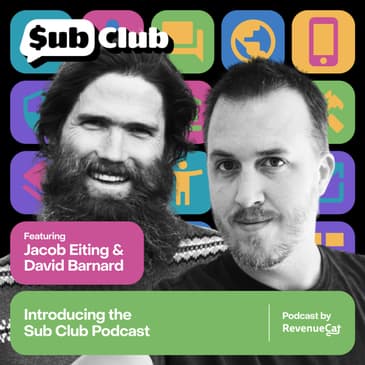
Welcome to the Sub Club podcast: a deep dive on building and growing subscription app businesses. Hosts David Barnard and Jacob Eiting will guide you through the ins and outs of subscription apps — sharing insider tips, predictions, and insights from industry experts.
In this episode, you’ll hear about:
(00:58) Meet your hosts David Barnard and Jacob Eiting.
(05:11) Sub Club is the first podcast focused on subscription apps.
(05:15) Personal SaaS is a nascent industry.
(6:18) The first billion-dollar mobile subscription companies; Lightricks, Calm, Headspace.
(16:50) How to submit feedback and suggestions for the Sub Club podcast.
(37:19) New platforms and form factors; AR
(44:15) The “AWS-ification” of mobile app development.
Follow Us:
David Barnard: https://twitter.com/drbarnard
Jacob Eiting: https://twitter.com/jeiting
David Barnard (00:03.491)
Hey, you're listening to the Sub Club Podcast, a show dedicated to the best practices for building and growing subscription app businesses. We'll share insider secrets from the top subscription apps on the app stores. Let's get into the show.
So, Jacob, so.
It's a club podcast. You tell me people want to hear about this stuff. People want to hear about subscriptions. Let's do it. Love talking subscription apps. I haven't I haven't actually spent a lot of time thinking about subscription apps in the last couple of years. That's really not in your plate. Really in the novice zone right now. I'm just kind of learning, kind of experiencing, just kind of taking it all in. Yeah. So maybe we should back up and maybe do just like a.
60 second overview. So the other person you hear is Jacob Eiding, CEO of Revenue Cat. He's my boss. Hello. Hi Jacob. Not really. I mean, we're collaborators. Hi David. Hi, you're welcome. Boss man. I just, yeah. So I'm David. I'm a developer advocate at Revenue Cat, but also any developer. I've been developing apps for 12 years now.
And this is a sub club podcast. So Jacob, why are we doing a sub club podcast? Because I cannot tie myself to a desk to write enough blog posts that are good. And we think this will be faster for some reason. That's part of it. And you can't tie me to my desk long enough to write enough good blog posts. There's too much happening, David. I can't focus for days. Like I used to be able to, to come up with a good long piece. You can, you can you do great. Long, long, long.
David Barnard (01:49.782)
But it's brutal. They are really hard, you know, art suffering is art or whatever. I made that up. Uh, but I mean, that's somewhat of a practical consideration, but really I think, you know, we've built through revenue cat and sub club, this community over the last three years, we've been meeting developers. I mean, that's our, our experience meeting each other was just being developers interested in subscriptions.
And yeah, so we felt like we're, we kind of monopolize this. We sit at this hub where we're constantly talking to developers who are building subscription apps, trying new things, uh, building software and new niches and learning stuff constantly. It's a really amazing to see like what all of our developers are doing and other developers we know are doing. And they're not always sharing publicly and they're not always, you know, cause just cause there's not a forum for it. And so yeah, we kind of felt like that knowledge is worth sharing because. You know, it's not these apps.
typically aren't super competitive. It's not like these are trade secrets or anything. So I think the more we can educate or share what we know, I think it's better for our mission of helping developers make more money, growing the GDP of the app store, kind of facilitating. I think the app store's mostly how fast it goes, but in this real transition period where as privacy gets more important as monetization methods outside of collecting money from your developers.
If you're from your users get less and less attractive, subscriptions are really just gonna be the way to do it. And so, you know, the more we can help developers bridge that gap, I think the better. Yeah. And one of the things I've really appreciated about my role at Revenue Cat is developer advocate is I felt like you've given me a lot of license to be like, hey, whatever helps developers go out and help developers. Like if we can help subscription app developers.
it's going to help us in the long run, whether there are customers or not, whether, um, you know, we're, we're directly making revenue off it or not. And so in a lot of the conversations I have in the, even in my approach to blog posts, like I really think about, like, is this for revenue cat customers or is this like, it's a public service. Yeah. And ultimately that, that benefits us, but it's like, I just love my role at revenue cat that I feel like I really
David Barnard (04:08.618)
I can be inside revenue cat and like be a part of the team and yay revenue cat, which by the way, we're not gonna talk about revenue cat much on this podcast. This will be the last time you hear of it. That was my only, that was my only real credential. But it is fun being in this role inside revenue cat while also being a customer of revenue cat, but then also just having a ton of leeway in my position to just help developers and like.
do whatever I can content wise. And that's why I like, I'm super excited about this podcast. Not just because I think that it's gonna be good for revenue kind of whatever, but I'm excited because I have two subscription apps in the app store. And like, I'm gonna get to talk to other great subscription app developers and learn. And so I think that that's the really direction we're headed with the podcast is that we're gonna bring people on.
who are successful in the industry, who are trying new things, who are knowledgeable about specific insights that they just don't get talked about a lot. Like there isn't another podcast focused on subscription apps. It's a nascent industry. I mean, it's been years, it's been five years or whatever since they started to break out, but it's still, we don't have, there's no conference, go-to conference for this industry. There's no like Canon for reading, you know, these, there are some big companies doing it like.
Netflix and things, but they're not really the same thing. Those are media companies doing consumer subscriptions, small time. I've heard it called, I've heard a bunch of different, she's like, see SAS consumer SAS, personal SAS. We call it a personal SAS. Yeah. And on that blog post, I wrote it. I mean, it's that's, and that's how early we are. We just really hasn't like coalesced around even a single set of terminology. And there's, there's starting to be some investors out there focused solely on these kinds of apps for starting to learn like what
causes an app to go from like good to great to forgive the business. I like there's, there are, so we're starting to see some patterns. Like what, what makes the difference between a, a small time meditation app and calm, right? What are the, what are the, what are the gaps to get to those like actually like public size company? And then lastly, we're just now starting to see our first billion dollar mobile subscription companies. So like tricks is my favorite go-to example. But calm and headspace are right there. I mean, I think. Colm's right there too. Yeah. Headspace there.
David Barnard (06:26.43)
And those, those companies will branch out of mobile and they have already, right? But it's, they were born there, right? And I think that's what we're going to see a lot just because of the ubiquity of phones, the, you know, and we don't have to dive into app store drama right now, but like the ease of purchase and the ease of use. And the, and the trust and like ease of trust, ease of subscriptions and ease of cancellation. Like I went to, let's not give them too much credit for ease of cancellation yet, but
No, no, no. You do have to give credit for ease of cancellation. Cause I went to, to cancel my, um, telegraph subscription. I did the free trial cause I was quoted in the telegraph. And you had to go through telegraph's website. And I had to go through the website and like, honestly, for a website cancellation experience, it was pretty straightforward. It wasn't the freaking New York times where I had to like call them up to cancel. It's true. But like, if you look at Apple's cancellation experience in the universe of terrible cancellation experiences, it's on the better side, but it could be better.
Like, come on, like you have to go into settings and it's like, you have to click on Apple ID. Like there's no, it's a really bad user experience and it really drives me nuts that they have an improvement. Anyway, that's a, they have it. Well, I mean, this is kind of stuff that's fun to talk about. It's a little bit of a tight baseball, but this is why we're talking subscription apps, right? This podcast is about subscription app. So let's just dive into this rabbit hole for just a sec. I complained a lot about this for a long time and I do think Apple's done two things that
that are really meaningful in this specific instance. Actually, well, three things. I mean, first of all, it really is so simple. Like you just go in there and once you find it, so we can set that aside for a second. But once you find it- Yeah, I was gonna say, there's a big jump there to like getting there. Okay, so once you find it- I'll give you that. Once you find it, I mean, it's one click. You don't have these like retention. That's what I was gonna say about the telegraph is like-
There's like this long retention survey. They offer you a discount. They ask you all these things. New York times make you call them on the phone. Like as far as like subscription services go. So like speaking of which we, my wife and I subscribed to urban air. It's like this jumpy place for kids. That's actually really cool. They have like crazy trampolines and stuff. So it's like in-person subscription.
David Barnard (08:37.79)
And we subscribed in person at this place. I cannot for the life of me figure out how to cancel this thing. Like they don't even have a phone number you can call or I called the phone number and like it was an answering machine. They never called back like subscription cancellations are just notoriously terrible. So from the very beginning, Apple has at least made it super slick to just tap one thing and say, cancel my survey. Are you sure? Yes. Done. Now, now can I make my counterpoint where I will
want to claw my eyes out when I'm, I'm clicking through settings and I got to remember that where they added a, like a root level link, but it's still obviously loads a really bad web view. That's really like janky and feels terrible. And it's like, yeah, that part, this could be fixed in a sprint, right? You have enough engineers, make it a nice experience. Apple like, please, you know, they moved it up like several layers. Like add a link though. It still goes to the same. It's still goes to the same thing, but they moved it up.
at least you go to the app store, you click on your account and the first thing you see of subscriptions, like where should they put it? Like, I mean, this is a really practical thing. Should it be a top level thing? Should it be a top level thing in settings? Or should it be? Yeah, I think so. I think so, and here's why. And it's bad for Apple and bad for us.
you know, more unsubscriptions, right? But I think that we can, that we can discuss. Is it bad for us if consumers are, I take the long view here and say like, well, just let people unsubscribe. You know, if they want to unsubscribe, let them unsubscribe. You're not doing yourself any favors. I mean, in the short term, yes, but like that's not why we're building software to short term steal people's money. We want to build these long-term as your, your thousand fans posts. So as Lincoln to show notes, uh, 10,000, 10,000. Sorry. I'm trying to get really low.
But like, I think, but honestly, I think this is the way apps should monetize. That's just like, obviously I'm going to say that, but like, not all apps. So, and I mean, yeah, that's true. We're in like three rabbit holes deep, but I mean, I tell people in my revenue cat office hours, like don't use subscriptions, because it doesn't make sense for your app. And if their app is not a good fit for subscriptions, they're not going to make much money.
David Barnard (10:48.626)
And revenue cash, not going to make too much money. So which is probably true in most cases, like unless you're building a marketplace or some other, we, some other thing that monetizes in completely different way, but if we're talking here about selling software, right. Software that solves the problem. Yeah. And, and software that's clearly valuable that, that has like value that's delivered over time, something that's meaningful. So like if you're building something meaningful for consumers that they're actually going to use and get value out of subscriptions are the better way to monetize and moving forward.
Right. And it's, it's a bit of like begging the question here. It's like, Oh, I'd say that because I'm the revenue cat guy, but I'm also the revenue cat guy because I believe that, right? Like it's, it's all, it's all a separately. So back to your point about where should they put it? Yeah. I believe absolutely. Like you should, I should open settings one click. Boom. I see all my subscriptions because it's core, right? It's, it's, it's the way we buy software. It's like you get this app, you know what? I'm not going to comment too much on the, the app store debates or whatever, but, but if it is a walled garden,
make everything really easy, Apple. Like use this position that you have to really just smooth out the whole process so that I know I can start a subscription because I'm not worried about canceling it, right? I haven't done, but I bet if you did a straw poll on how to cancel iOS subscriptions, I bet a lot of people are confused and frustrated because it's just too deep. But see, we did a deep dive in our data. I, and it's funny because like being inside Revenue Cat and the insights that we're able to see looking at our data and talking to our customers,
Um, when we did that deep dive last fall, looking at the cancellation survey, what we saw was that some people already had a low single digit free trial conversion rate. So there's like 95, 92, 90% of customers. A lot of people do know how. Yeah, that's true. It's so if there are people confused, it's a small and dwindling subset of
iOS users or mobile in general. Here's another non-scientific anecdotal data point, which is that if you search in an incognito window, how to cancel the first hit is, uh, see, or cancel your subscriptions, Apple support. Second hit is cancel pause or change your Google play subscriptions. So like, I think it's something that people still do have issues with. And also just, it just rubs me the wrong way. Like it just rubs me the wrong way. Like if a customer comes to me or I'm going to cat customer comes to me and says like, I don't want to use your service anymore.
David Barnard (13:15.018)
Like the last thing I'm going to do is be like, well, no, sorry. Like, or give them a bunch of hurdles, right? Like it's fine. Like the relationship's over. Don't cry. Like just go like, that's fine. Is we're, we're adults here in a business or transaction. We can, we can end this business transaction, right? It's the same thing. I don't want to just like pound it over and over again, but I, I do think that Apple they've, they have created some kind of monopoly here. I don't, is it a monopoly by the laws of the land? I don't know. That's for lawyers and courts to figure out, but they do have a lot of
power in this marketplace. And that just comes a lot of responsibility. Right? So I think it's not the purpose of this podcast, but I think something about our platform as developer advocates for subscription developers, it's important for us to make some noise and just like synthesize what developers are saying and try to get feedback back to Apple. Apple's a big organization with lots of people with good intentions, but, you know, influencing them never hurts to have like a few, you know, extra data points, touch points here and there.
over and over again, if we can help, you know, I want to. Yeah. And so to dive back into a couple of those topics, Apple did, and we wrote a post on this last fall. They did do the thing where when you delete an app, it prompts and says, do you want to cancel your subscription or still subscribe to this app that you're deleting? I wonder, and we actually should do a follow-up post on this at some point, or at least look at our data and share it. But I do wonder, like, we started to see a drop in iOS 13 of some of the conversion rates.
And so I wonder if we do see retention increase and like what kind of shift that that's caused. But again, it's like who goes in and delete stuff. And now in iOS 14, all the apps are just going to get shoved in the app drawer where people can forget about them. So they're not going to be going in and manually deleting the apps. And so things are changing. There's so many factors. There's so many factors to how the stuff we were really lucky with the switch. When we did that study on iOS 13, the cancel prompt and everything, we were really lucky because there was this week.
when iOS 14 got released where we had a natural AB experiment where half the people in the wild had updated iOS 14 and half hadn't there's some bias there. Sorry. Yeah. 13 to 14 or sorry. 12 to 13. Yeah. Sorry, sorry. There's a bunch still on 12 and then, right. So we had this really nice like week period where we had this natural AB test. It's not totally natural cause there's probably some biases to who updates sooner than others, but we'll, we'll put that in the footnotes. Yeah. So we, we
David Barnard (15:41.782)
we were able to actually like side by side measure. Now it would be much harder to try and look through like time and see if we can actually like suss that out. But, but yeah, I mean, it's interesting to see like, these things do have a macro effect and Apple's in a really strong position. So I don't know, it's, we just have to keep, we had to watch them all the time, right? Just part of the job. Yeah, exactly. So to like step back up three levels, I think we started this to say,
What can you expect from the sub club podcast? That is what you can expect from the sub club podcast. Random rants and discussions on the deeper inner workings of subscription apps and app stores. So to wrap all that up, if I do want to like get feedback from listeners on like the kind of topics that are interesting, the guests who we should have on the show and stuff like that. So.
Jacob is a boss man and has a lot more responsibilities than I do. So hit me up, david at revenuecat.com with suggestions for guests, topics, formats. We're probably gonna be a little bit experimental with trying some shorter episodes where we just do a quick hit on certain topics. We already do have some great guests lined up. So we will be doing guests and deep dives into different things, but.
We'll probably be a little experimental. So give us feedback as we go on, you know, what's working, what's not, what's more interesting, what's not. And, and we should talk to the, the philosophy being quality over quantity with this stuff, I mean, we want to create content that's not a good use of people's time, so it's hard. All right. Let's talk war stories. So, so this is going to be fun. Um, we just died for episode one, you know, Jacob and I have a ton of history in.
the app store. Uh, you know, I had an app out that actually let's start there. So, so it's a, there's no way to know. There's no way to know who was first. I had an app like August 11th. And the only reason my app was delayed is because I launched the, like the day my developer account got approved and Apple had been so inundated. I applied for the developer account, like literally an hour after Steve jobs left the stage in March of
David Barnard (18:02.85)
2008 is all very vivid for me since it's been so pivotal in my life. So yeah, it's about August 11th for TripCubbie, which was my very first app on the App Store. So it had to be in August. It had to be very, very close because I, I w yeah, I was not fortunate enough to be there on launch day. I mean, I was, did you have an account launch day and you just like screwed it up. So this, it was a weird summer. I was like,
working on an SDK company. So we were like 15. Right. I was like 40. I think I would have been let's see 2008. I would have been like 21 now because I turned 21 that summer. I turned 21 five days after the App Store launched. I don't know if that has any significance. I was like 29. Okay. All right. So, you know, we're in the same decade. Yeah. So I remember I wasn't I didn't have it on launch. I had somebody's like so there was this big
it into the pro del program. There's this big underground of like sharing credentials and stuff to like build on devices. So I had like gotten through like laundered I like literally as I like I don't know I do I either sold an iPod traded an iPod or traded some source code with somebody I did some like real shady under the table. This is gonna get my developer accounts gonna shut down.
I did some real shady transaction to get somebody's like dev certificates, but it wasn't the person I was getting it from. So it was somebody they had gotten it from. So it was a big, no, I know what it was. I traded source code for an iPod that they had pre-provisioned and then they gave me the like certs and everything. So I got set up. So I was working on that like in the summer. And then, yeah, I think my account got approved in August sometime. I think that's when they kind of like opened it up. And yeah, I had my, I had like this like paddle ball app that I had written in a weekend, like ready to ship, shipped it. Yes.
very similar. We just were in App Store Connect trying to figure it out, but there's a bug where you can't see original version launch dates, which is unfortunate. But yeah, it was early. That was a fun summer. Yeah. It's a very stressful summer for me. I mean, it's been 12 years, so I think I can share this. I was freaking out. I had just, my son had just been born. No, my wife had just gotten pregnant. My wife had just gotten pregnant. We found out in like May.
David Barnard (20:16.186)
I had jumped off the deep end to like start my company in, in April, like founding papers, like borrowed money from family members. And I was like, I gotta make this work. Like I gotta like, to the app store than me. I was at the time. That's a big bet. Yeah. It was a huge bet. I mean, I jumped off a cliff without a parachute. So in June,
Like I don't have a developer account. I didn't, I should have gotten to WWC. I, that was a huge regret. Like I could have just shown up that day and gotten a ticket at WWC. They would have like, my developer account. You went in 2008? Oh, I'm so jealous. I still have a lot of friends from that year that I hang out with. So, so I wrote this email and emailed it to every single person. I could find an Apple at Apple. And I was like, look.
I jumped off a cliff without a parachute. I borrowed money from family members. Sending ultrasound photos. I'm building this app and I have this vision for multiple apps. I mean, I had like a really detailed business plan. I had like a series of apps I want to develop around data tracking and stuff. And so I sent this email to like every email I could find at Apple and I got a call back and like I still stay in touch with that person at Apple that like reached out to me in 2008.
And the crazy thing was they still couldn't get me a developer account. Like they were trying to like get me in and like get, make things happen and help me out, but yeah, it was just a, it was a cold email saying, saying like, help me, I'm about to be a dad and I'm like going all in on this platform and you won't even let me like create a developer account. I don't know how I'm going to like make money and feed my family in the fall. So yeah, tells you a lot about the excitement around the app store, right? That that time was so
I don't know. I mean, maybe it's also cause I was like coming out of college. I was excited and that a lot. It felt like I was in a really good, the best decision I probably ever made in my life, a non-personal decision was. When, when Craig Hawken berries app came out for jailbreak that the Twitter one and like, I was big, I was already on Twitter and I was like, Oh, I can have a Twitter app on my phone. So I jailbreak my V1 iPhone, my, I don't know what they call it. M 68 I think was the like internal code name for it, but
David Barnard (22:30.094)
Nice. The old school plastic backed or no, it was metal. It was metal. Yeah. Metal backed iPhone. Joe broke it. Got, got jailbreak apps on there. And I was like, how do they even like, I had no idea. I had been like, I'd been studying programming and like, but like I had been doing PHP and stuff like this. I didn't really understand like how you even do interface code and things like this. So I made a really good choice. Like it's thing I ever did was I went out and bought the Hilligus book on Mac OS programming because there was no book. I bought that book. Yeah. It was, it's a great book.
in the whole universe of programming books that I've used. I think that's still one of the best ones as far as like the pacing and everything. But I did that and I learned how to make basically like Coco apps on Mac OS. And then that put me in a really good position when the app store came out and I don't know, maybe I had a hunch that that's how it would be done. I was like, oh, it'll probably be cook. I guess the folks making jailbreak apps, they had reverse engineered that, oh, this is just using Coco and like we can make apps with this.
So, so yeah. So then I was like, I was like ready when the SDKs dropped, I was like, Ooh, let's go. Um, and, and yeah, it was, that was, yeah, I just remembered that period from like, yeah, in March or whenever they announced the first, the first dev seed went out. And then I went to WWDC in 2000, in 2008. And that spring has actually moved to California to an internship at Cisco of all places, actually at Webex, ironically on a zoom call. Uh, and.
two weeks into it, I was like, this is the worst use of my time. Like, and I quit, I quit, they paid for me to move to California. And then I was like two weeks in, I'm like, now this is dumb. See ya. Sorry. Uh, also, also a good gutsy move I did. Cause then I spent the rest of the summer, just like iPhone hacking, helping people we launched. I launched this company called app loop with my friend Eric that was doing. The first, um, we were like very early SDK for analytics. Um, learned a ton there. Um, ultimately all of that stuff like flamed out and never.
turned out anything because it turns out if you're 21 years old, there are some 21 year olds who can run a business and do stuff like that. But like, I needed a little more baking before I get there. That was, yeah, a very memorable year. So it's funny how like our paths were somewhat parallel, but divergent. And, um, it hasn't fully, it really didn't fully dawn on me kind of the, my career trajectory and the early decisions I made that put me on this path.
David Barnard (24:47.826)
until I joined revenue cat things had become so much clearer. So I bought that book, the Aaron Hill, Hildegrasse book or whatever. In like the April 1st or March 25th or like days after the, they announced everything because I was like, okay, I'm going to build apps. I got to learn to program, but like, I didn't have a background in programming. I mean, I'd like kind of tinkered around with PHP and HTML and built some websites and CSS and stuff.
So I get like, you know, four chapters in like a week of like hardcore studying, but in the meantime, I'm like doing incorporation papers and like, you know, like trying to like start building up this infrastructure for a business. And I'm like, I'm not gonna be able to learn how to program and actually build something in two months or three months or whatever we were assuming at the time. It was like, this is not gonna work. And so I hired a contractor who
was a Coco programmer, Jonathan Johnson. I haven't talked to him in years. I should get back in touch. And it's interesting, cause like from that point on, I have questioned, should I have learned to code? And there's been so many times in my career where if I had just learned to code and I had the free time to do it, that I have had so much free time to do that stuff over the 12 years I've been running my business. And I feel like if I'd had just learned how to code,
build the stuff I wanted to build. Cause my struggle from the very beginning has always been engineering resources. Like I don't code. So I'm either paying contractors, which is always, you know, are they hourly or they buy project? And then the projects balloon and like, it just turns into a mess or gets super expensive. And then I started partnering with developers and that was, has been fantastic in some ways, but then- Better alignment, right? But then my app partners just like disappeared or gotten jobs or like get really busy in the day job.
And so then I'm like twiddling my thumbs, but then what has happened is that over this 12 years, you know, I don't twiddle my thumbs. I'm not like out paddle boarding 24 seven or like I end up. And this is where, like what led me down the path of eventually joining revenue cat is that I was doing deep dives into market research and analysis and really closely following what was going on in the app store. So all the time that I would otherwise have been like actually programming and building stuff.
David Barnard (27:12.618)
Instead of twiddling my thumbs, I was like reading blog posts, reading business books, thinking about marketing, like analyzing the app store, like watching the top charts every day, tweeting, writing blog posts. I wrote a, quite a few blog posts early on that kind of like got me more noticed. Um, and I wouldn't have done those things if I'd have been like head down programming the whole time. And so it's kind of led me here to where I am as, you know, somebody who has this like really weird mix of skills, because I do like.
you know, project manage and build apps. And I still have two apps in the app store, but I'm not coding. I'm not designing, you know, I'm not necessarily a great marketer, but I know a lot about marketing. And so it's like, there's just really weird mix of skills that turns out actually plays really well into my role as developer advocate. And then even just like the experience building my own apps. Yeah. I mean, I think it's, it's kind of a, um, it's a nice kind of look on what it does take to run an app business. Right. Yeah.
just to tie it all back together. You know, I think one of my attractions to the App Store as a marketplace and the Play Store and mobile in general, there's a few things. One, I love the form factor. I think tiny computer in your pocket has so much like access to data and your life. And like, there's so many ways to improve people's lives with that form factor. So that's like my first attraction to mobile. I would say you can hold a mobile, it's the only software you can hold in your hand really. Right? And that's really appealing to me. And then secondly,
It's the ecosystem and sort of the democratization. Like there, I don't know if it's true, but it definitely feels like you can, indies can thrive on the app store. Like if there's something about between the apps, I don't know if it's the app stores, play stores, distribution. I think distribution is part of it. I think the, just like the form factor does reduce scope slightly. Like PCs are harder to build for. There's more surface area. Like web apps are nice, but like they also have limitations, but there's something about
the mobile form factor and the mobile platform that makes it easier and more accessible, you know, and then sort of thinking about what that does is it creates a need for these like polymaths, like people who can code and, and it's really hard to do. We know people who do all of it and I'm
David Barnard (29:26.63)
blown away by them. Like amazing marketers, amazing developers. Like they do everything and it's hard, but they do it and their advantages can move very, very quickly. But their disadvantage is that like you're going to be doing everything a little bit less good. But, but all of those things kind of create this, this ecosystem, I don't know for, for just like interesting economic activity, right? Interesting little businesses that some of them get really big, right? You look at like a story like, and not to...
coming back to light tricks because like very few companies are going to be light tricks, but they started out very much like you. I don't know. They have a couple of co-founders. It was not, it was not a one person thing, but it was like, let's make an app. And then suddenly their app got popular and then it got bigger and they bootstrapped it for a while. And then eventually they were like, Oh, let's bring in some financing and like grow this thing. And it's a billion dollar company now. And that's like amazing. And they didn't even set out to do that. And initially, I don't think, I don't know, I can ask them, but, and that's just
Awesome. Right. That, that happens that exists, but outside of the app store, I think the stories are a little harder to come by potentially. But there's an interesting parallel to on the web. It's like, I feel like the early days of the app store were like the.com boom in a way. It's like, Oh wow. There's all this potential and have tons of people just throwing stuff against the wall and everything. And there was just massive growth. And so in a lot of ways, it feels like 12 years on the app store is so mature.
how could I possibly build a business in such a competitive market? Like, you know, every niche is already being well-served, but it's just not true. Cause like, we're like what? 40 years into the web and probably what? 20 years into like the consumer. Are we really 40 years into the web? Well, I mean like the web web, but like what I was gonna say is like 20 years into like the consumer web. Like. Yeah, mainstream web. Mainstream consumer web. So yeah, we're only like 12 years into.
the new mobile paradigm, but that, but it's, it's kind of like the, I would even make it less. I would even make it less because I don't think until subscriptions existed, we really had a functioning app store economy we had for some like niches, but the ad, the Apple really Apple and Google allowing more subscription apps categories really changed the way. I mean, everybody's been wanting paid upgrades for a long time. It's never going to come. I don't think Apple just decided. That's not what they want to do.
David Barnard (31:48.942)
they're going to do subscriptions and it's working for a lot of categories. Right. But it goes back to like, it, it does like create these sort of like this bar. Right. But to your point about niches and it being tapped out, like, I don't think so because there's a lot of people in the world that haven't really gotten to the point where software is top of mind. And if you believe in, you know, we all hope that quality of life continues to improve around the world is going to be opening up niches, things that we didn't even know needed software.
right? And there's going to be people there. And the beauty of the app store is that it creates a mechanism for people to build that for them. We're making an ad for like, this is going to show up in federal court. This is what's going to happen. It's like making an impassioned argument for the existence of apps for monopolies. But, but, but no, I mean, I, I really believe that. Yeah. And what's, what's particularly fascinating too. And, and, and I was trying to get to that is that, you know, we're 12 years into this new mobile paradigm, but
but we're not really 12 years in. And like what you're saying is like when subscriptions, when Apple opened up subscriptions in 2016, it happened around the same time, like penetration of smartphones has just been growing, growing and growing. But it's like started to level off just as like the real business of, it's like right around the time every adult in the world had a smartphone.
subscriptions and real business models were enabled by the duopoly of app stores. And so, so it's, it's like a perfect con, confluence of timing that you could really start building businesses all of a sudden when every single person, every single adult in the world who has disposable income or not has a smartphone in their pocket. So that's where like the, it's crazy to think 12 years on, but
It really feels like we're in the early days of opportunities on these platforms. I mean, look at, look at, look at what's happened in SaaS to like bring it back to web mobile web SaaS in general. Like we thought the.com boom was big. No, oh my God. Like look at the, look at the company's IPOing now they're huge and they're growing and they're, and they're providing, you know, what wasn't in the, and maybe you could draw some parallels between the.com boom and like app store circa 2008 to 2014.
David Barnard (34:07.946)
where it was like nascent and like interesting and niche and kind of weird and hard to make a business out of penetration. Like you don't, you didn't have as many people who are on the web who had a PC, right? And propensity to spend propensity to use online services, right? To buy software sit on the web and you know, for better or worse, the app stores are distribution model, right? And it's, and it's finally reached maturity. So I, I think now we're just starting to see
Yeah. And we're just starting to see the growth of this market. I'm yeah, I'm really excited. And then if you think about how this starts to play out over the next like 20 years, we're, we were, we've been talking a lot about personal sass and consumer stuff. And like I wrote that whole blog post in December, like personal sass, like consumers are warming up to subscriptions. Developers have the business model to actually build really valuable niche software that consumers value enough to start paying for subscriptions. So it feels like we're in the early days of that.
But what's the next phase four or five years from now, it's business SaaS being mobile first because people, I mean. Ooh, that's a hot take. That's a prediction. That'll be interesting. Because why not? Yeah, there's, I mean, that could be a whole episode talking about like, how did these like personal, because there's customers we've dealt with that are like kind of walking the line between like a business SaaS and like a personal SaaS. And like, how do we make that work? I think those are.
barriers that exist now that as the market develops, those barriers come down, will create even more opportunity. And so, yeah, I mean, I agree. I think we're really just crazy. I think 20 years from now, like what it's gonna look like. And I think the, you know, backing out of this, just the app stores and just mobile, right? I think that we're gonna see this trend repeated where we have new form factors. I think AR is one of them.
Apple's obviously working on something. Everybody's got something. And I would be surprised if we don't have anything around AR in the next 10 years. That's mainstream. And just like platforms we haven't even thought about yet potentially, like those are gonna keep happening. And I can't believe that this model won't get repeated for better or worse, right? Where the company that invests in the platform tries to capture the value by creating a distribution channel. And it's, you know, you could argue either way about what the fairness of that is,
David Barnard (36:26.862)
I think that software is going to democratization of the creation and consumption of software is going to keep getting pushed down further and further. And so yeah, I mean, it's good for consumers. And then, you know, for our shtick at revenue cat and on this podcast, like the developers are a critical piece in that chain, right? To get software delivered to consumers and make people's lives better. That's all we want to do here, David. We just want to improve lives. We want to help developers make more money.
And hopefully, improving lives, improving lives, improve the lives. But I mean, ultimately that's, I would have made that the mission statement of improving people's lives, but it's a little too broad. I think it's down the stack, but ultimately like that's actually part of what's cool about the subscription app model is that you can't build some like crap app that doesn't like a fart app is not going to
be something that people subscribe to be a really good fart app. But, but, but that would be an outlier. Who's going to pay a dollar a month for a fart app? Like does that bring value into people's lives? And that's where the subscription business model I do think aligns better with creating consumer value. And, and what's really interesting too, like going back to the whole like niche point and stuff is like, uh, you know, one of our customers built a subscription app for, for knitters. I like
I don't know how big that can be. I don't know how life. It doesn't matter, right? Because it'll be as big as it needs to be to support that endeavor, right? I mean, if it's big enough, the software will go away eventually. But. And an indie developer can tackle that. There's a much, exactly. There's a much better chance that niche will be served by an indie or like a mid market or some, the scale that niche can support will be filled now. Because we have this democratization, like all the way down to like the single app developer.
can build enough to get enough going in most cases. I mean, obviously there are some niches that are just too, too small that won't support something, but you can at least get some ongoing revenue if you want to do something as a side project. Right. So, so there's just like all these different like scales and back to like how, how we can help is there's a lot of analogies all like a lot of those, those developers doing the like a hundred dollar, thousand dollar, $10,000 a month app have a lot of the same problems as somebody doing a hundred thousand dollar, million dollar a month app, right? It's different scales.
David Barnard (38:50.446)
But they're still all worried about distribution and retention and all of these things. Yeah. And I think that's something that needs to be talked about. We need to have a space to discuss this. We do. And we said we were going to talk much more about revenue cap, but I just got to say one more thing. We should get a jar. Every time somebody says revenue cap, you got to put a dollar in the jar. We should do some kind of charity thing and donate every time.
The word revenue cat is spoken on the sub club podcast. Revenue cat donates 10 bucks to a worthy cause. I'm hoping I'm going to go down over time. Just spending that series a, um, no, but anyways, what I was going to say is along with that democratization up and down the stack, I think we play an interesting role, uh, we as revenue cat play really interesting role in that, in that we're providing tools that
would otherwise require massive teams like revenue kind of 17 people now or 18. I can't even keep track of 17 or 18. Do you, you probably don't even know. 18th offer went out, offer that. There you go. That's why I can't even keep track. Um, so I don't know that light tricks even has 18 or calm or head space even has 18 people just working on subscriptions. And so like last month when we hired a data scientist, I was like,
I've got a data scientist, like me, a little indie app developer. And that's, that's what's fun about being inside and being a customer of revenue cat is that like, I can see on the inside our roadmap and like where we're headed and know that as a revenue cat customer, I'm going to get the kind of tools that only large companies could afford to do. And so to stop talking about us, um, it's exactly what you're saying though, is that all they ever do is talk about revenue cat on this podcast.
But but the entire stack really is democratized from the bottom up like you like you couldn't have thought you know 20 years ago that a single person could build an app and then manage all the complexities of selling that app with collecting taxes around the world and everything like that and I think a lot of people take for granted like how much has Has been developed even just in the last five years like people act like oh, you know
David Barnard (41:08.01)
Why can't you just use Stripe on the app store? And it's like, well, Stripe didn't exist. Yeah, not that like five years ago. I mean, not in the form it does now, right? It's actually not accessible in some countries and like there's, the amount of work that the app stores do for compliance is insane. Like they do so much. Yeah. I don't even know this and maybe you can fill me in.
Distribe do a good job managing like VAT and like all the local sales tax. Like, are they actually making payments for developers the way Apple and Google have to like manage these incredibly complex complexities of local regulations and taxing authorities? Not, not, no, they don't, they don't know because they don't know in a lot of cases, they don't know what you're charging for. Like Apple knows that you're selling software so they can kind of put some rules on like what tax log it's applied to that.
Um, and Stripe is more general. So yeah, generally required to kind of do that on your own. And I think that's true. Somebody who's worked at Stripe can correct me. That's my understanding. And it's complex. Like a lot of SaaS companies kind of skirt this in the early days, just because like trying to, even in the United States, like you're supposed to collect sales tax for each individual state and, and you know, by doing estimates and stuff like that, but Apple like just takes care of Apple Google, everything for you. Yeah.
So it's amazing, like as this ecosystem has progressed that like I can go as a developer, use one signal to do my push and I don't have to like stand up a server and like deal with all those complexities. Like it's a service I might have to pay, but that's what's even great. Like about so many of these services, including revenue cat is that 10 bucks hit the jar. Is that so many of them have.
David Barnard (43:17.576)
And then you own the intellectual property. It's a capital expense, right? And so like, it's like,
in that sense, any piece of code you don't have to write is like less startup cost, which is better for iteration speed and like all kinds of things. So it's better for consumers. Once again, it's like developers. This is all very rosy. I'm sorry. Are we overselling it here? I mean, we're zealots, right? But that's, that's on purpose. Like we really do believe in this. That's why we, that's why we work on this, this company. That's why we're doing this podcast because like we do, I mean, and that's, that's the one thing that's fun about this group of people is like we've come together kind of under this common banner.
with, with backgrounds that are, you know, make sense and yeah. And then just tying it into what we want to do with this, this brand or this sub club media empire is, is just try to, I would really love like my long-term vision for sub club, like revenue cat, like you said before, like that's a way, that's a way for us to, we'll make money, whatever. It doesn't matter. We'll figure that out. Like we're going to, we're already making
David Barnard (44:19.978)
That's that that's not here or there. And like, you know, whatever sub club, honestly, like there's benefit to the company, too. So that's what we're doing it. But but, you know, for us, if we can contribute, if we can help, I would love to see like a community form that can bring developers together that are in this that are in this industry. Right. Because there's when an industry gets really developed, there's a lot of things that like there's a lot of things that crop up more services.
connections, like hiring leads, like, like two tricks and tools of the trade, right. And that can all be facilitated through communication. And so I think that's, that's something that, that I'm hoping to like build up with this sub club community over time. Yeah. And podcast is just to start. Stay tuned folks. But speaking of which, we had like a ton of notes on like other stuff we could have talked about, but I don't think there's a better way to end than, than
having talked about our zealotry for the real. And I mean, you know, as, as much as we can, there's so many negative things that we can talk about. Social media addiction, addictive, psychologically manipulated, free to play apps, subscription scams, like all these things that are absolutely negative things. Yeah, they're all very real, right? Very real, very real. But there is this like core element that technology
David Barnard (45:47.499)
I mean, the pandemic has been a perfect example of like, my kids getting to FaceTime my parents and like we face some time. I'm like 10 times as much now, even just to like brighten my kid's day and brighten my parents' day. And like, you know, Apple powers that, you know, for better or worse, duopoly or not like Epic store, like all the crap that's going on, like with battles and stuff, it's like at a fundamental level, there is
there's good for humanity that can be done and is being done through technology. And so our zealotry for it is, is for the potential of that to continue and to continue benefiting society. And hopefully we can, hopefully we can push on some of those, those downsides too. Like that's, that's something we kind of talked about with the cancellation thing and, and stuff. I mean, that's another benefit sometimes, well, good trade organizations is you do like, can.
conform standards and stuff like this, like the MPAA and things like that. In order to avoid state regulation, you like do some self regulation, which honestly, going back to like the subscription cancellation nightmares you were telling us about at the beginning, like that's almost a place you would expect to see state intervention at some point where there already is in Quebec. Free trials don't auto convert. That's a, that's a, that's an interesting little bit of sub club tidbit for you there. Any subscriptions on the app store originating in the
province of Quebec do not auto convert to subscriptions. Wow. I did not even know that. I guess that's the kind of things when you manage four hundred million dollars a year in App Store revenue, you start to see some of these edge cases. I had no idea that was the case. I mean, I'm sure it's written down somewhere. I just to draw the greater point is I do think there's probably subscription legislation in the future as it could be, you know, as things become less business oriented and more on the consumer.
eventually like consumer protections will come in and stuff like that. And I think that's an area that we'll be able to help with too, hopefully. Yeah. So did we cover everything? Wrapping this, wrapping this up? No, we didn't. We could talk for like four more hours and barely cover a notes. My favorite part of this, David, is we get a second one on one every week. That's nice. This doesn't count Jacob. I have so much to talk to you about. Boss man.
David Barnard (48:00.798)
Yeah. So actually I would love to, to maybe do another show sometime, just you and I talking war stories. Cause there's some fun stuff we could talk about from the early days. We kind of gave a glimpse into it talking about the very, very early days, but there's a lot that's happened in 12 years and you worked at Apple and elevate and stuff. I've built like 20 different apps and had various levels of success. So we'll have to, we'll have to do another show where you and I just kind of, I think we can spread out the bonus building a little bit over time.
There you go. I give it all up in the first episode. So, yeah, let's wrap up. This is way longer than we intended it to be for an episode zero. But hopefully this was really fun to listen in on. Well, we'll be able to cut most of it. So don't worry to trim it all. So wrapping up, if you want to follow Jacob, he is J. Iding, right? That's a Twitter.
You can find me. Just how do you spell? I'm not hard to find Jacob. I think Jacob revenue cat Twitter. You'll probably find it. Yeah. Search Jacob revenue cat. That's probably, I should just change my name legally. And then I'm Dr. Bernard on Twitter. He and I both rant like you probably don't want to follow us on Twitter. Should we just say, don't follow us on Twitter at the end of every episode? No, no, no. Follow Jacob. Not me. I already have enough. I already have enough followers. I'm embarrassed. Spread the love around a little bit. I tweet.
Um, and then, um, yeah. And then, so we're going to have a feed for this podcast. Uh, we're actually creating a separate site for sub club. And so we will probably be posting various, you know, might do some direct content just for sub club. Um, so keep an eye on, on the sub club website. Do we have a URL for that yet? No. Look at the posts. Well, add in the show notes.
I think we're still, uh, still figuring out what the domain is going to be. Just in time. We're doing things just in time here. That's in time. Sub club. Um, so yeah, check out the website, follow us on Twitter and, um, expect to see. So this episode zero, we're going to probably record through four episodes, um, ahead and launch with multiple episodes in the queue. So you probably could go on from this and just listen to a couple more episodes. And, uh, yeah, exciting things that come talking subscription apps.
David Barnard (50:24.166)
and consumer benefits and obscure random topics that most people don't want to talk about. But we do. Thank you, David.
To make sure you never miss an episode, subscribe to the show and your favorite podcast player. Thanks so much for listening. Until next time.