
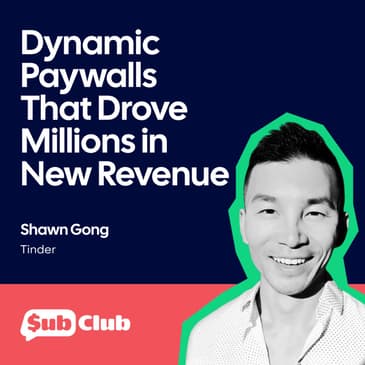
On the podcast: how Tinder's ML-powered paywalls drove millions in new revenue, the art of selling features à la carte without killing subscription revenue, and why Tinder Select flopped despite users saying they'd pay for it.
This conversation is shorter than usual and will be featured in RevenueCat’s State of Subscription Apps report. Each episode in this series will explore one crucial topic and share actionable insights from top subscription app operators.
Top Takeaways:
🤖Users need fewer options, not more
Decision overload kills conversion. Tinder saw multimillion-dollar annual revenue gains by using ML to predict and surface the single best product for each user instead of showing every tier and plan at once.
🎯Anchor a la carte prices to subscriptions to prevent cannibalization
Unbundling features can capture non-subscribers, but pricing too low steals from subscription revenue. Tinder priced its standalone Passport feature equal to the weekly equivalent of a full-featured subscription, making the subscription the obvious better deal.
🧠 Design for emotional decisions, not logical ones
Users don't read every feature comparison and weigh their options rationally. They decide in seconds based on feeling. Observe how users actually behave, not how you assume they should, and build your purchase flows around that.
About Shawn Gong:
🚀 Product Growth & Monetization at Tinder, the world's most popular dating app, with over 55 billion matches made across 190+ countries since launching in 2012.
Follow us on X:
David Barnard - @drbarnard
Jacob Eiting - @jeiting
RevenueCat - @RevenueCat
SubClub - @SubClubHQ
Episode Highlights:
[0:00] Introduction to Shawn Gong, Product Leader in Monetization & Growth at Tinder
[1:05] The challenge of decision overload and how Tinder tackled it with dynamic pricing
[2:47] How machine learning helps Tinder predict and serve the right product for each user
[4:25] Simplifying user choices: Reducing overwhelming options for better conversion
[5:48] Shifting from static to dynamic pricing: The role of AI in optimizing Tinder’s paywall
[7:06] A/B testing the dynamic pricing model: How Tinder validated the ML model's effectiveness
[8:12] Unbundling features like Passport mode: Meeting specific user needs without subscriptions
[9:33] The impact of pricing changes on conversion rates and subscription cannibalization
[10:57] Long-term retention metrics: Measuring the success of dynamic pricing beyond just revenue
[12:00] Tinder Select: Lessons from launching a high-end tier and why it didn’t work
[13:18] The importance of aligning product offerings with user emotions for better decision-making
[14:25] How Tinder continues to optimize pricing strategies through iterative testing and learning
[15:48] Shawn’s advice for startup founders: Focus on retention and building better product decision design
David Barnard:
Welcome to the Sub Club Podcast, a show dedicated to the best practices for building and growing app businesses. We sit down with the entrepreneurs, investors, and builders behind the most successful apps in the world to learn from their successes and failures.
Sub Club is brought to you by RevenueCat. Thousands of the world's best apps trust RevenueCat to power in app purchases, manage customers, and grow revenue across iOS, Android, and the web. You can learn more at revenuecat.com. Let's get into the show.
Hello, I'm your host, David Barnard. Today's conversation is shorter than usual and will be featured in RevenueCat's State of Subscription Apps report. Each episode in this series will explore one crucial topic and share actionable insights from top subscription app operators.
With me today, Shawn Gong, a product leader building monetization and growth engines for consumer unicorns, including Tinder and Grindr. On the podcast, I talk with Shawn about how Tinder's machine learning powered paywalls drove millions in new revenue, the art of selling features a la carte without killing subscription revenue, and why Tinder Select flopped, despite users saying they'd pay for it. Hey, Shawn, thanks so much for joining me on the podcast today.
Shawn Gong:
Thank you so much, David, for having me. Such a pleasure. I always love your newsletter, podcasts, and all the content, so what an honor to be here with you.
David Barnard:
Oh, thanks so much, man. Well, so I've had several ex Tinder employees on the podcast, but I'm super excited to get you on because I haven't gotten to talk to somebody who's been in the trenches the last few years. And Tinder's done a lot of cool stuff on the monetization front, so I wanted to dive into a project I know you worked a lot on, and that's AI-driven pricing. So what was the problem, what were you trying to solve, and how did things go?
Shawn Gong:
Yeah, I'm very excited. So let me start with the core problem, because that's really shaped everything we built at Tinder. So the user problem is decision overload, simplified to put it that way. So as you might know, Tinder has a lot of purchase options from multiple subscription tiers, and then under each tier there is multiple plans, like weekly, monthly, and then we have a lot of a la carte products.
So it's great, because we have so many product for user choose from. However, we talk to users and we notice two things at least. One is some user, they bought the Platinum, the highest subscription tier we offer to everyone, simply because that's the most expensive one. So their belief is that, well, I'm willing to pay the most and then I'm going to get the best, so I'm going to buy Platinum, which is great.
However, we noticed some of the users who bought Platinum, they only use the features under our second tier Gold. So they realize, oh, actually you bought something you didn't even fully use, you could have just bought our Gold subscription tier to save you money. Or maybe another issue can be like, we can do a better job to educate users, hey, there's other features from Platinum, you should take advantage of them, you haven't used them yet.
Another thing we notice is some users, they didn't buy anything simply because they were overwhelmed. It's like, oh my gosh, so many options, I don't want to pick. And then also reality we learn is maybe David, you have your own experience. When you look at particularly your RevenueCat, specialists in paywall. So one common mistake a lot of companies make is they describe all the features or benefits. Benefits are better than feature, yes. However, do you think user going to read through them and make a decision? No. That's what we thought you are going to do.
Okay, let's compare Tinder's Plus, Tinder's Gold, Tinder's Platinum, and then compare the a la carte and then make decision. Now, user make decision within a second, so it's our job to help them to make decision better. So that's from the basically user problem is like decision overload and then so it's overwhelming.
And then from the business problem is, of course, that leads to relatively lower conversion, right? Because for some user who wanted to buy, but they were overwhelmed, they decide not to buy and then that lower conversion. So that's a classic case of misalignment incentives. So we wanted to maximize revenue, but our UI experience made it harder for user to make a confident decision.
David Barnard:
Yeah. And I mean, Tinder famously, I mean, this is why I have you on, and so many people in the industry have talked about Tinder because it's led the way in this hybrid monetization, but having three different levels of plan and then y'all tested out a fourth level of plan, we'll talk about that toward the end, hopefully if we have time, but it does get super confusing. And then you have the boosts and the other in app purchases and things like that. So then what did you do to actually to solve that and to make it more accessible to folks and getting people to the right plan?
Shawn Gong:
So that was challenging, but luckily we had a brilliant machine learning team. So when I talked to the team members and then they told me, "Hey, we can try to build ML models and then use that to predict users willing to pay and then we can surface the best product they're most likely to buy." So that's our solution. Because based on the insight we talk about it's like people, customers don't need a lot of option. They need the right one.
Think about like Netflix, how many users are like, "Oh my God, I don't know what to watch." There's so many choices, they end up spending hours scrolling and then now they can't watch anything. That's why Netflix have something like top picks for you, right? Based on your previous behavior and your ratings, they predict what you're most likely to watch. So solve that problem. So very similar.
So this is a huge moment for us, I think, particularly even for Tinder, for the industry, is we shift from stale pricing to dynamic pricing. So we don't show the same paywall, same product to all the users. So think about, let's say, David, you are willing to buy Platinum, why should we show you Plus? I mean, that's a problem, not just from business perspective, we won't be able to maximize the revenue and then we can use that to reinvest to make product better for you.
Another problem is you don't get to enjoy all the best benefits we can offer, simply because you chose the Plus. So that's why the solution come within, we use a machine learning, we train the model, and then we eventually release the model for that to predict and serve the best SKU for customers.
David Barnard:
How do you test that? What was the AB test? It was just these standard kind of deterministic normal, everybody gets this paywall at this part of the flow and then everybody gets that paywall at that part of the flow? And did you just do an AB test to prove that the ML decision model was better than what you had before?
Shawn Gong:
Yeah, spot on. Yes. But obviously to reduce the risk, we couldn't just start it from all the paywalls because we have a lot of different paywall. And then the same times that's very expensive and it takes a lot of time and then effort to train the model, to test the model. So we start with something small. So we test with a couple features and then just start with not all the scope.
So we can see, hey, based on this machine model to historically, a version, a control will be same as we used to show the paywall and the products. To the new one, this is dynamic. We will change basically when they show a user, let's say for David, and then our paywall will ask the ML model, "Hey, which paywall should we show?" And then the paywall will decide, okay, which product we should recommend to David. And then that's how we test the treatment and then we'll be able to measure the conversion and then the total revenue.
David Barnard:
And how did it do?
Shawn Gong:
It's great. Yeah. So based on our prediction, I think it's definitely multimillion dollars annual increase for Tinder. I also want to clarify, for that, it's not just maximum revenue, it's like an evil business plan. No, it's like the money we're going to use, we can reinvest to the product so we can improve our user experience and then build more benefits for customers.
That's why when I talk to a lot of startup founders, I always advise them, "Hey, don't wait to think about your monetization strategy." You don't feel bad to charge users. They wanted to pay you and they deserve it because you're going to provide better experience for them, not mention to compete with your competitors and be able to move faster and sooner.
David Barnard:
What about counter metrics? Were there anything you were watching to make sure things didn't go south in retention or user experience, that people weren't happy with the plans that they were presented?
Shawn Gong:
Tinder has a really good process in place and then we are required to also measure our counter metrics. This is great because you cannot only focus on one area. For example, for this case, we cannot just only focus on the first time conversion and then only the revenue amount. So we have to measure, hey, let's say David, based on our model, maybe prior to that, he will buy a Plus. Now he bought Platinum. So we want to check, hey, is David going to come back? Is David going to buy Platinum again? Is he going to cancel?
So we definitely measure those long-term success metrics to make sure this model really served correctly, because that's nothing that we wanted to continue to work on. Most product features, it's not like launch and done, that's it. We have to optimize user rate. So we wanted to learn, hey, we actually have different models. We build a different ones we want to compare, so we want to see how they perform between those models, same time, how they perform compared to the paywall without the models so we can make sure we focus on long-term success.
For the takeaway for this example is the real unlock wasn't just better pricing, it was a better decision design, helping users to choose a product that truly fit them. So for your product, any founders or startup out there, even you don't have a ML team yet, I think maybe the simple way you can do is design three products or tiers for the customers. Why? Because that's a very common or easy way for a user to pick from. Some will want to buy the most expensive one. Some of them just want to buy the cheapest one and then someone don't know how to make decisions, they buy the middle one.
So that's usually the simplest way for you to design your product here, because actually change how decisions are made. Let's say, David, if we only offer one product, so your decision is, should I buy or not? But if for David we show you three products, now you are thinking, which one should I get? So you bypass the yes or no, and then it's more likely to convert.
David Barnard:
Yeah, that's fantastic advice. I do wish we all had ML Teams, maybe that's something at RevenueCat we should be working on to help folks build those kind of sophisticated things into their own apps. But anyways, I did want to move on to this idea of monetization unbundling is that not everybody wants the full subscription, not everybody is going to fit into the Gold, the Platinum. So how do you think about unbundling that?
Shawn Gong:
Actually, your probably know that we had some unbundling products already, a la carte, such as Boost, Super Like. I think a couple thing you want to think about besides one issue you've already highlight is not everyone want to have a subscription, right? Subscription is great, I mean, don't get me wrong, because you get a package. It's much easier than you have to decide which features you wanted to pick from and then to buy that way, it's painful. It's easier to buy a whole package and then repeat it renewal automatically so we haven't think about it twice.
But there were some use cases, think about Boost, I think it's perfect a la carte product. Why? Because it depends on when you want to use it, when you don't receive enough likes, so you want to boost yourself. When let's say you swipe during the peak hours, so you wanted to use that. So that makes sense. Super Likes too because it's like, well, I don't know how many Super Likes I'm going to send, it depends on who I see in the app.
And another use case we decided to try is the travel mode, also aka Passport mode. It's allowed any users to see anyone globally. So it's so cool. Let's say you can go to Paris, go to Spain, wherever you want to go based on your needs can be basically you want to travel there or you want to just meet people there. And then think about that feature is like not everyone wants it, right? Maybe because it's very special case for needs for certain people, in that case, that feature is a great candidate as an unbundled feature stand alone. So that's how we think about what features make sense to be unbundled and designed for our customers.
David Barnard:
How does the Passport mode work? Is it a one-time purchase for a limited time? Is it an add-on subscription or how does it work exactly?
Shawn Gong:
Yeah. So historically this feature is part of the subscription, so you have to get a subscription to use it. And then, like we talk about the challenge for that is for some users, they only want to use it when they plan to travel or to meet people outside of their home city. And then they might not want to buy a subscription because they just don't want to have that commitment or they don't feel like they need to use other features. So that's a perfect candidate for them.
So we test out the features. So that helped us able to capture non-subscribers, for the users who just want to buy a la carte for this Passport feature, and then they can use it for one day, three day a week based on the offers we provided, and then they can enjoy that benefit to meet people anywhere in the world.
David Barnard:
So how have things been going with the Passport feature and it being unbundled from the subscription? Have you seen uptake?
Shawn Gong:
Yes. Actually, I think it's so fun to talk about this because it was not launch and then success story, that's it. Not that simple. We learned a few things based on our test. First thing is when we launched this standalone a la carte Passport feature and then the conversion went crazy. It was great. However, we noticed like, oh, that hurts our Plus subscription because some user decided to only buy this feature not to buy subscription.
But that can be a couple of things. So one is, oh, maybe we price too low, it's too affordable and then so it's like no-brainer, so user use it. The second thing we do is like, oh, we should increase the price for a la carte and to see how that will change the conversion and then subscription cannibalization. So we definitely noticed that the subscription cannibalization reduced as we expected, and then the conversion reduced a little bit, but total revenue actually went up. So that was very positive.
And then we continue to test because we wanted to minimize the subscription cannibalizations. And then we increase the price again and then also have upsell on the paywall. Basically we show, hey, David, you can buy Passport, standalone a la carte, but also you can buy Plus subscription. And then we use a very interesting kind of psychology thing. Basically for our seven-day Passport feature a la carte, the price is the same as seven day Plus subscription.
So that case, David, you think like, oh, duh, then the seven-day plus subscription is a better deal. I can get it more than this feature. So that also helped. Of course, it means reduce the cannibalization, also increase the conversion revenue, but it's still not good enough. So we decide, hey, let's use our perfect ML model again, so we will show users subscription first. If you don't want to buy subscription, we show you a la carte, so we'll give you a second chance.
David Barnard:
I love hearing these kind of stories because I just think Tinder's been around so long and so many of us in the industry look up to it as a pioneer in monetization in apps, and I just think so many apps are leaving money on the table by not experimenting with these kind of things and not trying all the different... Three tiers. And like we said, it can lead to confusion. It's not the right thing for every app, but there's just so much opportunity to meet users where they are and charge them.
And then speaking of which, Tinder Select was a really interesting experiment. So I'd love to hear from you how that went. It just sounds fantastic, and we've talked about on the podcast many times before, add a super premium tier, we talked about it earlier, like some people will just buy the most expensive thing. So sounded like a really interesting idea. How did things go with Tinder Select?
Shawn Gong:
Yeah, I think Tinder Select is a very interesting case study in terms of the product market alignment and the behavior science. So let's start with the hypothesis. Basically the opportunity Tinder was exploring, why Tinder created Tinder Select, because Tinder has a massive global user base. And then we also have some whales, basically the user who are willing to spend a lot of money, they buy a lot of high subscription and then a la carte. They spend a lot of money with us to maximize the outcome. So we definitely saw, hey, there is a willingness to pay out there. Let's try if we have an even higher end tier and then provide even better service and product, would user buy them or not? So that's basically the process we had.
And then so that would be different segments we're targeting, obviously. And then same time for the, I think the challenge are two things. One is the identity fit and the brand positioning, right? Because for any products, not every company can just offer a high end. It's really ruled into what is your brand is and then how customer thinks like a good fit or not. I think for Tinder, because we catering for the massive population, and then in that case, it's a little bit difficult for some user to feel like, oh, it's a good fit for me to use it.
Think about that, David. If we tell you, "Hey, you're going to pay $4.99 a month for subscription on Tinder." And then when you come to Tinder, you see people you might be able to see even just use a Platinum subscription. Now you might think like, okay, I don't feel that special here. Maybe you give me some special treatment, added benefits, but I don't feel like the environment people here that are special. That's just difficult.
It's very common. Think about a club too. It's like exclusive one, very expensive one versus just a regular one, but you have expensive table. So think about that scenario. I think that's what make it challenging. It's like a luxury offering, but people might not feel the benefits meets their expectations.
David Barnard:
What's the future of Tinder Select? Is it going away? Is it going to evolve?
Shawn Gong:
Yeah, I think that we're just not going to expand much further and then just gradually scale down for this one. It's not like a fail, it's basically like we learned what we initially wanted to, and then we realized it is not worth the continual investment and the [inaudible 00:20:35] for us to have this feature. It's not the best fit for us. We have better bets to continue.
David Barnard:
Well, I think it's super cool that y'all tried and a great lesson as always that people don't always do what they say in a user survey or a user interview. So always a great lesson to remember. But you should try and that's a great thing, and then you did and you learned. Is there anything you wanted to share with the audience as we do wrap up?
Shawn Gong:
I think the most important thing I want the audience to realize or understand is don't treat your users as they're logical human beings. So what I mean by that is you cannot be like, oh, let me design this product and the user going to read everything on the screen, they're going to make decision based on information I share with them and then make a purchase decision, whatever they want you want them to do, right?
No, reality, they don't do it that way. They don't follow your user experience. They don't just read everything to make decision. So they are like us and we make emotional decisions. I think that's very important. So that's why we have to really observe how they behave and talk to them and to really, truly unlock the emotion behind that, otherwise, you are going to make wrong decisions.
David Barnard:
Where can people find you or are there any jobs you wanted to shout out at Tinder?
Shawn Gong:
Oh yeah. I think Tinder definitely is still growing, has a lot of fun opportunities, so encourage people to check out. It's one of the best places I've ever been because it's really fun culture, very progressive, and then really care about people's life. When I go to the cafeteria every time, I get emotional because I see the wall, we show all the user who wrote letter to us, show their wedding pictures. Oh, our work made a difference, made people having a new family together, how lovely that. And then sometimes also if you wanted to grow your product without hurting your retention, and then I can help you to unlock user emotions and design defensible growth loops, and then you can find me on LinkedIn and then MentorCruise.
David Barnard:
Awesome. Thank you so much for joining me. This was a really fun conversation.
Shawn Gong:
Yeah. Thank you so much, David. It's always my great pleasure talking to you.
David Barnard:
Thanks so much for listening. If you have a minute, please leave a review in your favorite podcast player. You can also stop by chat.subclub.com to join our private community.